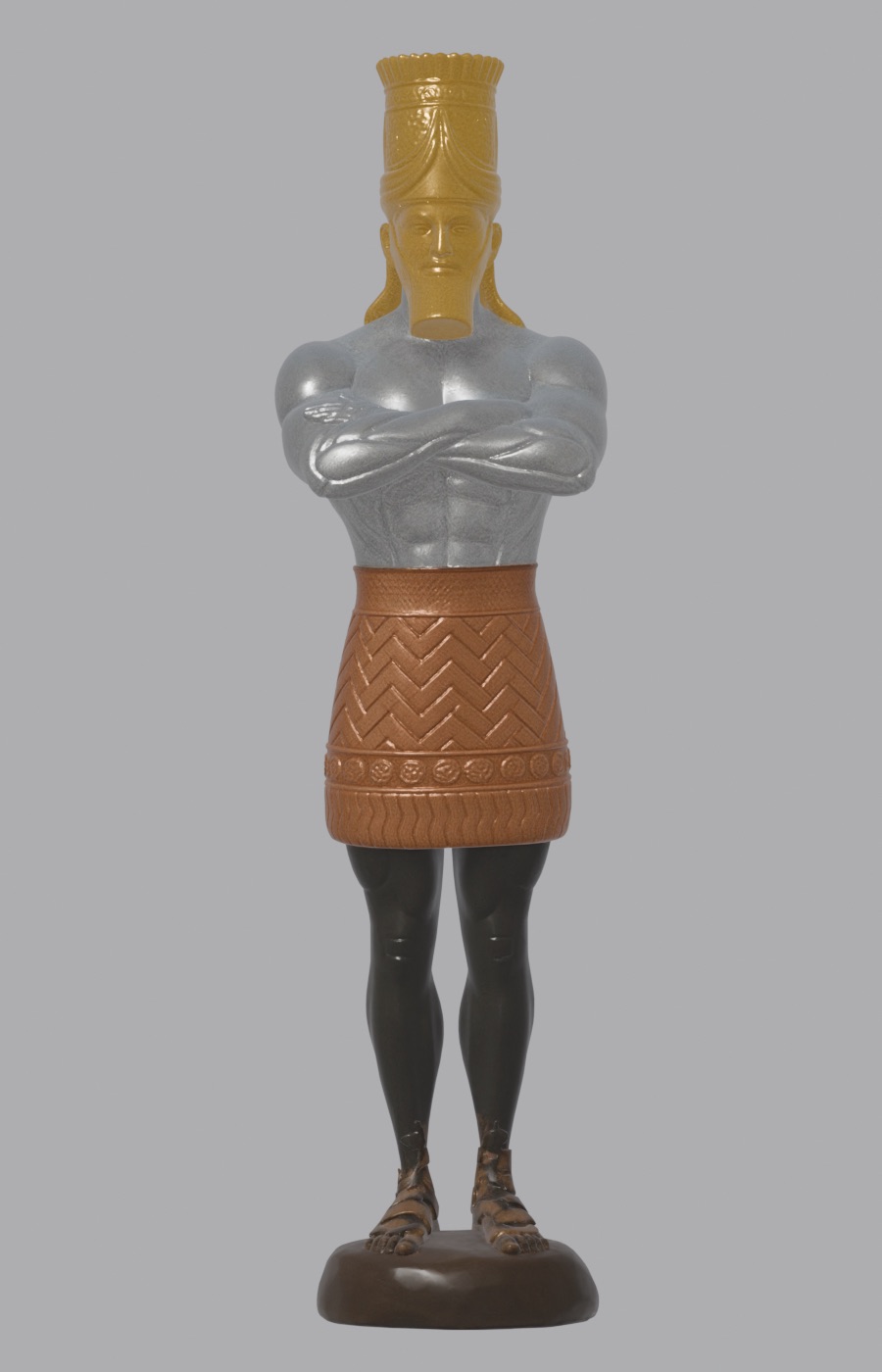
“You are this head of gold.” Daniel 2:38, NKJV Daniel tells King Nebuchadnezzar plainly that the head is him and the empire he rules. The God of heaven, Daniel says, has given him a kingdom, power, strength and glory, and placed people, animals and birds under his hand.
Gold suits Babylon well. It was the richest city of its age, famous for its walls, temples and hanging gardens. This is the only part of the statue that the chapter names outright; the later kingdoms are identified from the rest of Daniel and from history.
“After you shall arise another kingdom inferior to yours.” Daniel 2:39, NKJV A second kingdom follows Babylon, lower in worth than gold. Babylon fell to the Medes and Persians in 539 BC, the night described in Daniel 5, and Daniel 8:20 later names "the kings of Media and Persia" directly.
The two arms are often read as the two peoples joined in one empire, the Medes and the Persians, with Persia becoming the stronger partner under Cyrus.
Daniel 2:32, 39
Belly and thighs of bronze · 331 – 168 BC
“A third kingdom of bronze, which shall rule over all the earth.” Daniel 2:39, NKJV A third kingdom of bronze takes over and reaches across the known world. Daniel 8:21 names Greece as the power that defeats Medo-Persia.
Alexander the Great conquered the Persian Empire with astonishing speed around 331 BC. Greek soldiers were known for their bronze armour, and Greek language and culture spread from Egypt to India.
Daniel 2:33, 40
Legs of iron · 168 BC – AD 476
“The fourth kingdom shall be as strong as iron.” Daniel 2:40, NKJV The fourth kingdom is hard as iron. Just as iron breaks and crushes everything, this power breaks the kingdoms before it into pieces.
Rome fits the picture: it absorbed what was left of the Greek kingdoms and ruled longer than any of the empires before it, with an iron discipline. Its two legs are often linked to the later division into a western and an eastern empire.
“They will not adhere to one another, just as iron does not mix with clay.” Daniel 2:43, NKJV The feet and toes are part iron and part clay. The kingdom is divided: partly strong, partly fragile. Its peoples will try to bind themselves together, even through marriage alliances, but they will not truly hold together.
After Rome fell in the west in AD 476, it was never replaced by a fifth world empire. Europe broke into nations that have often tried to unite, by treaty, by royal marriages and by conquest, and none has rebuilt a single empire. The statue has no fifth metal.
“The God of heaven will set up a kingdom which shall never be destroyed.” Daniel 2:44, NKJV In the dream, a stone cut out without human hands strikes the statue on its feet of iron and clay. The whole image shatters, gold, silver, bronze, iron and clay together, and the wind blows it away like chaff from a threshing floor. The stone then grows into a great mountain that fills the whole earth.
Daniel explains that, in the days of these kings, God will set up His own kingdom. It will never be destroyed or handed to another people; it will break all these kingdoms in pieces and stand forever. No human power builds it. That is the point of the stone being cut "without hands".